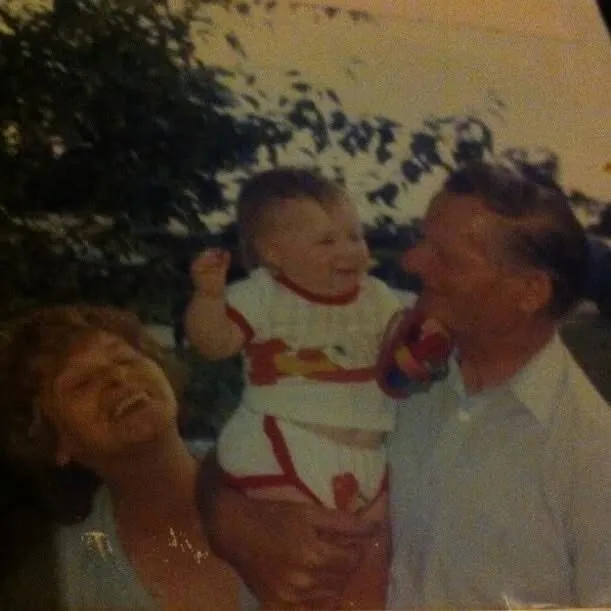
In the new year I needed a break. Life had got too much, so we went to the Lake District to see Sy's nana and stomp the blues away over the Cumbrian mountains.
She's one of them. Those hardcore nanas that just aren't made any more.
I don't know if it's because her name is Pat, like my nan. Two Pats, who never knew each other. My Nanny Pat was a cook, a homemaker, made parachutes during the war, creator of the best crochet blankets around. She was full of love and warmth and comfort. She had lupus, so she was always in and out of hospital, she gave her bed for people who were more sick than her. This Pat also a cook and a homemaker, she taught art, came from Grantham was a twin. Different women. The same name.
My middle name is Patricia. I am a Pat.
My 5 (my nanny pat had divorced and was living with her boyfriend Bill - who very much was my grandad) grandparents all died at least 15 years ago, and being around Pat made me miss them in a way I hadn't expected.
I want to hear one more story.
Wave one more silly goodbye.
Blow one more raspberry kiss.
Eat one more perfect potato — show her I can almost make them too.
On my mum's side of the family, I feel very lost. There's a big gap of history, especially on my mum's dad's side. (There's not 6+ grandparents because we never knew him, nor did my nan find anyone else) All I know is he came from Cornwall for generations.
He didn't want my mum or her siblings.
My aunt tells me stories every now and then and I feel gobsmacked I didn't know them earlier.
It feels like I never really knew my mum, yet she taught me so much — crochet, sewing, cooking, compassion, empathy, selflessness.
Some of what she taught me hasn't been useful, that selflessness has turned into people-pleasing and anxiety and as I try to undo it I find myself needing to know where it came from.
That's the whole point of generational trauma — but when your history book only goes back to a handful of stories you remember your mum telling your teenage self, it's a different kind of heartbreak.
Another layer of grief. Deciding what to keep and what to put down.
I think about Pat. Ninety-three years old, still drawing, still teaching at her village art club, still walking into storms to post handmade Christmas cards. Still telling stories.
A few years ago she drove into Ullswater lake. We visited her in hospital, bandaged up, and brought her a sketchpad and pencils. She sketched the exact spot where she'd crashed — precisely enough that we found it later from her drawing alone. She was broken and still very skilled.
She told me stories that week we stayed. Stories about her childhood, her brother, her life. She was writing his eulogy. Nobody else in the room was really listening — they had heard all the stories a thousand times before.
I listened like she was my nan. I made notes when she talked about her funeral wishes. She wants someone to recite Leisure by William Henry Davies. And as she started — What is this life if, full of care, / We have no time to stand and stare? — I found myself saying the words with her, almost surprised I knew them.
I was transported without warning: back to my grandad's allotment in Berkshire, wedged among the towering sweet peas and the sweet williams, the taste of homemade raspberry jam on my lips from the just warm Victoria sponge that was made by my nan.
Somewhere I hadn't been in decades. There they were.
Not as a memory I'd chosen to visit — as a presence, woken up by a 93-year-old woman in a Lake District dining room.
I grow sweet peas and sweet williams now. For Grandad Willy.
Every story she told mattered and I didn't want them to go the same way as so many others. How her and her twin dated the same guy, how she was to marry the old rich man in the village because she was the carnival princess. Setting her bed on fire playing with matches and her dolls house being ransacked by her brother and his mate.
She relights something in me every time I see her.
Not because she's comfortable and agreeable — she's not. She'll tell you when you're wrong without hesitation. But she is completely, stubbornly, beautifully herself. And in a world that quietly dulls you down, that's a radical thing to witness.
She's proof that the knowledge doesn't have to be lost.
Sometimes you just have to show up, bring the pencils, and listen.
Listening to her made me wonder what I'm holding that I haven't named yet.
As I get older I'm aware that being a child-free adult means I don't have anyone obvious to pass things on to. And sometimes I feel like I haven't even started living yet — but that's a lie. I've got stories. Some of them aren't fun or exciting like travelling the world or going to an amazing party, but I've got insights and knowledge earned from trial and error.
Things I didn't realise I knew until someone asked.
A friend is starting a women's circle and asked me to talk about gardening.
My first instinct was no — I've got nothing to share. But then I remembered a simple gardening nugget that might prove me wrong.
When you want to sow seeds, feel the soil first. Is it cold? If so, wait. It's too early.
A simple piece of information that took me years to actually understand. Now I take off my shoes when I get to the allotment. Before I've even opened a seed packet, I know not to bother — I can feel it with my toes.
But I didn't get there by accident.
An elder allotment resident told me to stop reading the packets and start feeling it.
For a long time I didn't understand what they meant. I didn't even stop to ask at the time.
It was only when a hot sunny day caused my feet to burn on the soil that I realised my plants must be suffering too. I watered them well, and they grew better the following weeks. By feeling the heat, I grew better.
A small sentence from another person, lodged quietly in my mind, changed how I garden entirely.
What other words are there, waiting somewhere in my memory, in my intuition, for the right conditions to show themselves?
Waiting for me to be ready to grow.